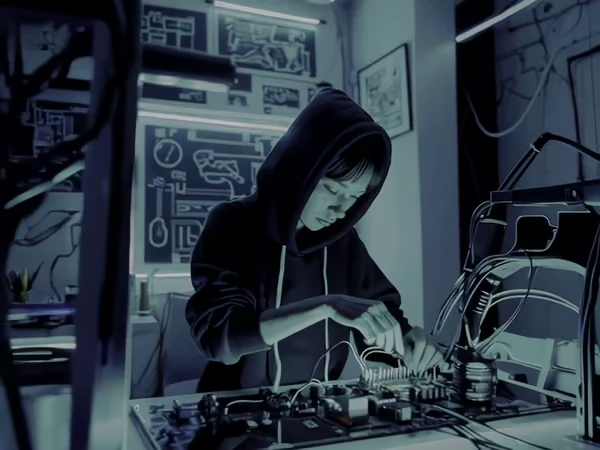
Before we ask for more hardware, we ask more of the code.

We investigate how much analysis, rendering and interaction modest machines can handle. Peer-reviewed methods provide the foundation. Memory, latency and real workloads put them to the test.

Computing laboratory · Illustration

01 / Areas

The problems we work on.

We want to redefine process intelligence: make the calculations understandable, the evidence inspectable and the software useful on hardware people already own. Our engineering work puts these requirements into running systems.

01 / Process intelligence

Delays, rework and handovers

We investigate how event records reveal bottlenecks, repeated work and handover delays. Processing time, recorded waiting and missing evidence describe different things. We keep those distinctions visible in the calculation and on the screen.

Read the Observatory measure definitions and worked examples.

02 / Formal methods & reproducibility

Verification and reproducible calculations

A convincing chart is not enough. We investigate formal verification of critical logic, type constraints and reproducible calculations. Peer-reviewed academic work provides the foundation; explicit assumptions and checkable results connect it to the software.

Reproduce a published sample finding with SQL. The sample lets you inspect the rule, its inputs and its result.

03 / Edge ML & computing

Local inference on constrained hardware

We investigate machine learning on ARM and other constrained devices. We compare accuracy, response time, memory use and CPU–GPU transfer costs to establish where local inference is useful and where the hardware gets in the way.

For Observatory, the practical question is whether an optional advisor can answer within a local device’s limits. AI access is separate from the deterministic analysis.

04 / Interactive systems

GPUs, input latency and simulation timing

A slow frame is a problem you can feel. We build games to find what holds modest GPUs back and work around it. Rendering, simulation and input compete for time and memory. The Observatory Reader faces those constraints too.

Play Rally Protocol for a working interactive example, or inspect the Reader screenshots.

02 / Practice

A calculation you can reproduce.

Take the published Observatory sample apart. Its claims are synthetic; its inputs, rule results and verification queries are available to inspect.

Follow the finding to its rows
01

Question

Test one recorded condition: did the same person assess and approve a claim?

02

Evidence

Establish which records support the check. The rule checked 224 claims. 76 could not be checked and are reported separately, never counted as passes.

03

Experiment

Check the published result with plain SQL. The result file returns 224 checked claims and 109 hits.

03 / Standard

How we test our work.

01

Name the method.

State the method and its assumptions. Show which question it answers.

02

Measure the claim.

Compare speed, accuracy or improvement against a defined baseline. Record the conditions and enough detail to repeat the test.

03

Keep missing evidence visible.

Keep missing values distinct from zero. State what the evidence leaves unresolved.

04

Try to break it.

Test contradictory inputs and boundary cases. Record the failures and use them to improve the design. The synthetic sample result identifies 3 rejected source rows and explains why they were excluded.

Published methods you can examine.

The mathematics should be available to the people using the results. Read the formulas, worked examples and limits behind event-count concentration, duration distributions and open-object estimates. Each article identifies its Observatory snapshot.